Wrist Tendonitis
It's Not Carpal Tunnel But It's VERY Similar
Do you have wrist tendonitis symptoms anywhere from fingertip to elbow?
Does the level of pain make it difficult to get work done or complete simple tasks?
Are you experiencing swelling or inflammation and pain that makes putting pressure on your wrist or even just the day to day use of your wrist uncomfortable?
If you’re nodding your head ‘yes’ to any of these symptoms then you may be experiencing tendonitis of the wrist and even be on your way to getting Carpal Tunnel Syndrome.
Did you know that Wrist Tendinitis is commonly misdiagnosed or confused with carpal tunnel syndrome?
That’s right. Carpal Tunnel and tendonitis of the wrist share many of the same symptoms, and all of the same causative factors.
There is good news though — you CAN reverse the problem (both of them).
We can show you how to differentiate between the two scenarios, and better yet, how to prevent and reverse wrist tendonitis.
But first, let’s learn more about it.
Feb 1st or sooner!

What Is Wrist Tendonitis?
Tendonitis of the wrist — more commonly referred to as wrist tendinitis — occurs when one or more of the tendons that connect to and/or cross the wrist joint become inflamed. Most commonly this happens due to micro-injuries caused from general wear-and-tear
That's that everybody else on the internet (and your doctors in their offices) will tell you. It's true but useless. 'Inflammed tendon' is a SYMPTOM. And you want to effectively address THE CAUSE.
The REAL cause is the Pain Causing Dynamic, which consists of multiple factors, primarily:
- Too tight muscle and connective tissue (pulling on the tendons 24/7)
- Process of Inflammation (which releases chemicals which enhance your sensitivity to pain)
- Nutritional Insufficiency (your body can't function properly without the nutrition it needs to do so)
Wrist Tendonitis is caused almost entirely by the above three factors. They make your body function poorly. And then it can't withstand the downsides of repetitive motion or repetitive strain.
Wrist Tendonitis Symptoms range from mild to disabling, depending on how long the issue has been there and the type of movement performed.
The most common symptoms of Wrist Tendonitis include:
- Forearm and/or Wrist Pain
- Decreased Range of Motion
- Sharp and/or Shooting Pain
- Chronic Ache and Feeling of Tightness
- Loss of Hand Strength
- Numbness
- Increased risk of Dequervains Tendonitis- (Meaning that problem can spread to your thumb.
If you follow the tendons with your fingers all the way up to the muscles that attach to the tenons, you will find 'hot spots'.
What Is Carpal Tunnel Syndrome Then?
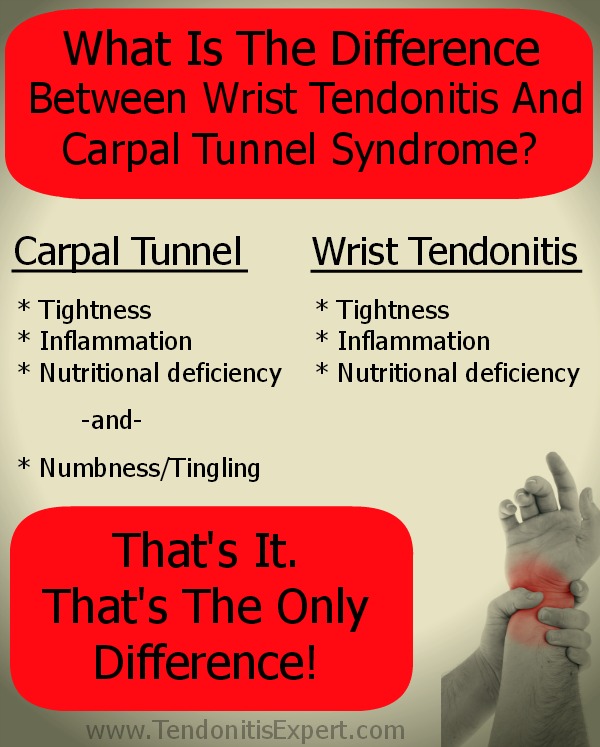
Carpal Tunnel Syndrome — or CTS — is the name of a label given to a set of Carpal Tunnel Symptoms.
We often call it CTS when you experience pain in the front side of your forearm or wrist, coupled with numbness or tingling in the fingers.
Did you know, you can have Tendonitis of the Wrist and have Carpal Tunnel Syndrome (CTS), or you can have Wrist Tendonitis and not have Carpal Tunnel Syndrome?
Read on to learn more, or you can learn how to how to reverse wrist tendonitis here.
What are these ‘tendons’ you keep talking about?
Tendons are composed of strong collagen tissue that attach a muscle to your bone. They are inelastic, meaning they aren’t stretchy like muscles.
- Wrist tendons, specifically, join the muscles on the front and back of your forearm and attach to the bones of your wrist.
- They work together to pull your wrist up, down, side to side, in a circular motion, and to various angles. They also stabilize the wrist while the fingers work.
- As you use your wrist, the tendons slide through their grooves (aka. Tendon sheaths) over and over, and too much use leads to tiny micro rips, tears and irritation from the friction.
- The tighter muscles are, the more tension and friction they exert on the tissue that they rub against.
By the time you feel pain you have already had a Pain Causing Dynamic firmly in place for a while and your nervous system has long ago started a Process of Inflammation.
How do you know if it’s Wrist Tendonitis or Carpal Tunnel Syndrome?
Here's a simple way of telling the difference between the two.
1. If there is Tendonitis on the palm side of the wrist that involves the Carpal Tunnel and results in numbness/tingling in the fingers and pain, that's likely Carpal Tunnel Syndrome.
2. If there is pain and inflammation with any of the other tendons that cross and/or attach to the wrist, then you're looking at Wrist Tendonitis.
___________________
The good news is - curing wrist tendonitis is simple.
Start fixing this problem here.
____________________
It gets tricky, when you have Wrist Tendinitis on the back side of you wrist -and- have numbness in your fingers.
If you have numbness, doctors are generally going to make the Carpal Tunnel Syndrome diagnosis.
You may notice how similar the symptoms of Carpal Tunnel Syndrome are to the symptoms of Wrist Tendinitis.
Do You Have Wrist Tendonitis?
It is important to understand what exactly Tendonitis is.
Tendonitis can show up pretty much anywhere in the body (anywhere there is a muscle/tendon structure, that is).
Make sure that you understand the answer to the question: What Is Tendonitis?
There is an all encompassing aspect of Tendonitis that Western Medicine fails to take into account, especially with Wrist Tendonitis and Carpal Tunnel Syndrome.
The aspect is that when there is pain, muscles get tight.
Connective tissue connects EVERYTHING in our bodies. Connective tissue in the forearms and wrist gets shrunk down and constricted when you have Tendonitis.
The constant motion that comes with repetitive strain injuries, literally causes wear and tear on tendons. But that's not all...
You also have constantly too tight muscles and constrictive connective tissue.
When you have Tendonitis anywhere between your hand and your elbow, that constricting connective tissue not only helps compress nerve leading to the hand, but the 'carpal tunnel' can be compressed from all the local shrinkage.
This is why Carpal Tunnel Syndrome is so over diagnosed.
The Carpal Tunnel may be compressed but it generally is not actually the problem.
Carpal Tunnel Release Surgery, aside from all it's other downsides, is doomed to fail if 'releasing' the tunnel doesn't release or reverse the source of all the constriction and it doesn't. It won't. It can't.
What All Tendonitis Has In Common
Tendonitis is Tendonitis. No matter where symptoms show up.
The medical community gives the impression that Carpal Tunnel Syndrome, Intersection Syndrome, Cubital Syndrome, Tendonitis of the Wrist, etc, are all different issues.
However, when you look into it, you will find that they all have the exact same Pain Causing Dynamic, but in different locations.
Having Wrist Tendonitis for the most part is no different than having Tendonitis anywhere else. It follows the same rules.
They each have some specific indicators and variables, but there is an underlying dynamic that that all share. Deal with the dynamic, and they all get better quickly.
If you have Tendonitis in the Wrist, it can be dealt with easily and effectively, click here to fix this painful problem.
Watch This 'Basics' video
What You Need To Know About Tendonitis Of Wrist Tendons
There are some important points to know about tendonitis of wrist tendons.
- You can have Tendonitis on wrist tendons on the palm side of the forearm, or the back-of-the-hand side of your forearm, or both.
- You can and may not have true tendonitis (injury), -and- have mild to severe inflammation which makes it FEEL like you have an injury, (which could even feel like a 'hot spot' on your actual tendon).
- You can have tiny, minor damage to the tendon -and- a huge, ongoing pain response that just continues to make things worse over time.
- Whether you have Tendonitis on wrist tendons or not, what you REALLY need to worry about is the Downward Spiral the body goes down due to the Pain Causing Dynamic
- There is much more information about this on the relevant pages of this website.
If you have tendonitis of wrist tendons, there's an entire dynamic that's much bigger than just the tendons themselves.
Don’t worry - you can still reverse the injury. Click here to start fixing your wrist tendonitis.
Do You Have Wrist Tendonitis?
If you have Tendonitis in the Wrist, you're lucky.
That’s right — we said you’re lucky.
How?
Well, it is a safe bet to make that you have pain and inflammation because you have been doing some sort of Repetitive Motion, resulting in a Repetitive Strain Injury; essentially Tendonitis.
If you have the RIGHT information (like you will find on this website), dealing with tendonitis of the wrist can be quick and easy as opposed to other kinds of injuries that cause serious, hard to repair injury.
For instance, as I write this, I'm almost a year into a L5-S1 ruptured disc experience. While I've found methods that help a GREAT amount, I haven't yet found a quick, cheap, easy cure.
My point is, I wish I had wrist tendonitis instead of a disc issue. I'd be pain free in a week.
I’ve learned how to reverse the early symptoms easily - you can read more about that here.
You can learn how to get out of wrist pain and keep yourself out of pain too. If you've done what the doctors told you to do and you're still in pain, you might think that the previous statement is impossible.
And it will continue to be impossible if you keep doing activities that don't help.
- Curious about why you have pain, why you have reduced range of motion and loss of strength, and how they all work together? Then find out more about Wrist Tendonitis Symptoms.
- Curious if Wrist Splints and Wrist Braces help Wrist Tendonitis?
- Are Corticosteroid Injections a good way to deal with your pain? (No they are not.)
Tendonitis leads to inflammation which leads to pain which leads to tight muscles which leads to inflammation which leads to pain.....
Do You Need Surgery For Tendonitis Wrist?
These symptoms can lead doctors and people like you to start looking at Wrist Tendonitis Surgery as an option, after the other options fail.
Surgery for Tendonitis of wrist tendons has been shown to help wrist tendonitis. Research and studies show it to be effective....depending on how you look at the numbers.
In my professional experience, getting surgery on the wrist tendons due to wrist tendonitis either:
- Doesn't help at all, plus you have the pain and issues from having the surgery
- Helps for a short amount of time, but then the pain comes back
Aside from the potential negative side effects and dangers of Wrist Tendonitis surgery, surgery does not deal with the Pain Causing Dynamic, the progressive pattern, that Carpal Tunnel and Wrist Tendonitis share.
The same pattern that caused the pain in the first place.
You can learn how to reduce wrist tendonitis WITHOUT harmful surgery here.
One Missing Piece
There is an all encompassing aspect of Tendonitis that Western Medicine fails to take into account, especially with Wrist Tendinitis and Carpal Tunnel Syndrome.
The aspect is that when there is pain, muscles get tight.
Connective tissue connects EVERYTHING in our bodies. Connective tissue in the forearms and wrist gets shrunk down and constricted when you have Tendonitis.
The constant motion that comes with Repetitive strain injuries, literally causes wear and tear on tendons. But that's not all!
You also have constantly too tight muscles and constrictive connective tissue.
When you have Tendinitis anywhere between your hand and your elbow, that constricting connective tissue not only helps compress nerve leading to the hand, but the 'carpal tunnel' can bet compressed from all the local shrinkage.
This is why Carpal Tunnel Syndrome is so over diagnosed.
The Carpal Tunnel may be compressed but it generally is not actually the problem.
Carpal Tunnel Release Surgery,
aside from all it's other downsides, is doomed to fail if 'releasing'
the tunnel doesn't release or reverse the source of all the constriction
and.....
It doesn't, won't, and can't.

How Do You Make Your Pain Go Away?

If you want to eliminate your wrist tendonitis pain, I suggest you get the 'Reversing Wrist Tendonitis' program.
Carpal Tunnel and Wrist Tendinitis share the same dynamic of tightness and inflammation. The pattern is similar except for a couple little differences.
Here’s what you’ll learn in this 58 page no-nonsense, BS-free guide to reversing wrist tendinitis:
- Why immobilizing your wrist isn’t the answer
- Concise and direct instructions to help you get out of pain quickly
- Activities that directly target the root cause of your pain
- And so much more!
There is no magic cure or effortless fix to wrist tendinitis, but we guarantee that if you follow what 'Reversing Wrist Tendonitis' shows you to do, in a short amount of time you can either be totally pain free, or very close to it.
So what are you waiting for?
Download the ‘Reversing Wrist Tendonitis’ program Instantly.
If you follow what 'Reversing Wrist Tendonitis' shows you to do, in a short amount of time you can either be totally pain free, or very close to it.
Wrist Tendonitis Questions and Answers
Do you have wrist pain, forearm pain, and think or know that you have Wrist Tendonitis?
Ask any questions you have about your situation. To save time and back and forth, make it as detailed as possible. History, symptoms, age, what makes it better, what makes it worse, how long it's been like this, what started it, what you have done to try to help it so far, ets.
MAKE SURE TO CLICK THE NOTIFICATIONS BOX AND LEAVE YOUR EMAIL ADDRESS IF YOU WANT NOTIFICATION THAT I RESPONDED TO YOUR QUESTION!
The following Q&A is free!
Other Questions and Answers
Click below to see Questions and Answers from other visitors to this page...
Tendonitis for 6 months, as a teenager. Can't workout properly and therefore can't be happy. Depressed. 
Hey Joshua, I've had Tendonitis for almost 6 months now, I'm 18 years old , and 6 months ago, at the gym I tried doing a bicep curl with a straight bar …
Please help my severe right wrist pain tendonitis
I have had right wrist pain for almost seven months now. I am not faking.
No history of injuries. 32 yr old male.
Injured at my job and went on Modified …
CNA with three failed surgeries for DeQuervain's Tendonitis. What can i do? I'm so sick of all the pain
Hello!
.
I was injured in 2013 at work; I am a CNA and work with elderly patients. I was diagnosed with De Quervain Tenosynovitis. I've tried everything …
5 years Post Wrist Surgery - Still having pain and cysts
After playing guitar for 15+ years, unexpectedly I developed a hand injury.
It came about during a period where I was traveling and NOT playing guitar. …
24-year-old Oboist
Hello Joshua!
I have been playing oboe since I was 10. I majored in it during college, and though I ultimately decided to make teaching music my full …
Carpal Tunnel and Wrist tendinitis / decreased range of motion / continuing to get reinjured
Hello and thank god for a website like this. I have been digging for answers for too long....
I am a graphic designer and a sign maker so I use my …
Drafting vs. Drumming and getting Wrist Tendonitis
Hi Joshua,
I’m looking for an explanation with regard to wrist tendonitis. I have correct posture, relaxed wrists, support etc, etc. I have done …
Poolonitus?
--SORRY, THIS PAGE'S FORMAT IS MESSED UP---
Hello Joshua,
I think you are a "terribly" good man! I just had this "terrifying compulsion" to blurt …
Pain 1 year 4 months. Guitar RSI? Help. I feel frustrated.
I did this to myself. I'll admit it.
Music became my favorite hobby when I was 15. I loved playing the guitar. (I say loved, because I don't play it …
14 months of wrist tendonitis for pianist and music director
Hi! My husband is 31 and has been struggling with wrist tendonitis in his right hand for 14 months. The problem is that he is a music director and his …
Where to start with all over tendonitis wrists, elbows, shoulder
Hi, I am a 32 year old female and I have had wrist tendinitis on and off for over a decade, I usually put my wrist in a brace and it goes away.
Over …
Piano player tendonitis in both wrists with possible nerve damage...
My name is Kristen Polomoscanik. I am a 32 year old vocal music teacher and have been for the past 10 years. I play the piano 5 days a week for at least …
Chronic Wrist Tendonitis in Both Wrists | Designer | 24 years old |
I've had wrist problems for quite some time.
In high school I developed it after doing gymnastics (poorly) for long periods of time. It prevented me …
Having trouble figuring out whether it's carpal tunnel or wrist tendonitis from basketball
Hello, a few weeks ago I started having wrist pain from playing too much basketball. Since then I've went to many doctors and some have said it's tendonitis, …
tendonitis in my right wrist from computer use and capoeira
I started having problems with my wrist in October 2010. At that time I was living abroad and working as a Teaching Assistant. I had just finished college …
Tendonitis all over - started in foot and arms
I am 29 years old and have had chronic tendon inflammation for about 10 years. First I was diagnosed with plantar fascitis which resulted from walking …
Bank teller with wrist pain on the backside right in the middle...
Hi,
I have had this wrist pain for at least 10 years now. When the problem first started, I went to the doctor & I was immediately tested for carpal …
Extreme hand/wrist/arm pain for over a year, still no diagnosis!
I am 29 years old and have always had excellent health. A little more than a year ago I began having numbness in both hands when I woke up in the morning …
Popping Wrist and Elbow Tendinitis with Dequervains
About a year ago I sustained an injury to my wrist through repetitive use of lifting with my wrist a heavy object.
I am uninsured but have had physical …
68 year old asks Did I damage wrist tendon whilst weight training?
I am 68 years old, left handed and have Parkinson's disease.
6 years ago I was working out on weight training equipment when I felt something snap …
Wrist Tendinitis due to weight lifting is not going away
Hi, I came across your website and I find it really useful so Thank you. My doctor said that I have wrist tendinitis and he told me to take an anti-inflammatory …
10 Year Old With Wrist Pain and Numbness in Fingers
Hello. My son, age 10, has been complaining of discomfort in his wrists recently. Specifically, he has pain on the side of his wrist at the joint between …
Injured woodwinds musician who needs help with shooting wrist and arm pain!
I am a professional woodwinds player looking for a proper diagnosis for the shooting arm pain and symptoms I am experiencing. I typically play saxophone …
Shooting wrist pain and numbness when I rotate wrist or push buttons or holding a spatula or knife
Hi! I think I have wrist tendinitis: I cannot rotate my wrist without pain, and I especially cannot do many things right now without shooting pain and …
wrist pain but no swelling
Hello, i have been experiencing pain in my right wrist, on the inside, below my thumb for about 2 weeks. i am not quite sure what i did to it. i do work …
16 Year Old With Wrist Pain From Intersection Syndrome
My daughter has been diagnosed finally after 5 months with Intersection Syndrome in her wrists. We have been to physical therapists and several doctors …
42 year old new mum with wrist and foot tendonitis
Hi. My baby is now 10 months old and I've been suffering from wrist tendonitis since she was a week old. I also have pain in the tendons on the top of …
Tendonitis pain from Carpal Tunnel To Shoulder, Doctor Wants To Do Surgery
First I want to thank you for ALL the information in your website. I read other ones but yours is GREAT!!
This is my history: I'm a 42 years old woman, …
Can't lift a coffee mug due to Wrist Tendonitis pain
Hello, I'm 49 male, generally in good shape. I'm a regular runner and gardener and in overall good health, although I have been taking an acid blocker …
23 year old male have had bad right wrist now for 3 years
Hi there, I am 23 year old male and I have had a bad right wrist now for just over 3 years (on/off).
I cant remember how I even injured it in the first …
Shooting Pains in Wrist When Doing Bench Press
I would like to know whether this could be wrist tendonitis or carpal tunnel syndrome.
Over the past 2/3 years I have on and off used weights, such …
20 year old drummer with newly diagnosed tendinitis in wrists on both sides.
I have recently been diagnosed with tendinitis of the wrists on both sides.
The pain started coming on about month ago and a little over a week ago …
Lifting weights, pain and swelling in wrist and forearm, took a month off but it's back
Ok so about 3 years ago I started working out and lifting weights. A few months in all of a sudden one day my wrist puffed out bug time. It looked like …
Rock climber who can't open the fridge door without wrist pain!
Hi Joshua,
I'm 21 and have been rock climbing for about a year now, mostly indoors. About five months ago I started having pain in my wrists when I …
Animation Tendonitis, rest hasn't helped, can't work
Hello. Thanks for the information on your website it's great. I wanted to share my situation with you to see if you think this will ever calm down. My …
59 year old mowed the lawn now has wrist tendonitis and/or carpal tunnel syndrome, and trigger finger
I am 59. I mowed my lawn in early June, for about 1 1/4 hours. I have done so for many years, with no problems, previous to this time.
But that night, …
13 year old guitar player and video game player with painful tendons in wrist and forearm
Hello, My Name is Joe. I am 13 years old and not sure what to do. I've been experiencing pain in the tendons of the palm side of my arm and slightly in …
13 yo girl wrist injury immobilized 5 months
My 13 year old daughter injured her right wrist in a fencing tournament last September. She and another competitor clanged bells.
Later in the tournament …
1st time mom with debilitating Tendonitis from holding new baby
Hi,
I had a baby 5 months ago. 2 months ago my Chiro took one look at my shoulder placement on my left arm, then my wrist and said I have tendonitis …
Tendonitis Repetitive Strain Injury from Baskin Robbins
Hi Joshua,
I'm an 18 year old student going into university next year.
I've been working at my local Baskin Robbins scooping ice cream for 2 years; …
4 years suffering from wrist tendinitis from playing piano!!!!
Hi Joshua!
Please, help me..... I am a pianist (33 y.o.)since I was 6 y.o.
Had no problems with playing the piano. I had 3 year break in playing …
Scared pianist with wrist tendonitis and arm pain
I am a pianist. I started feeling pain before my last recital, but kept practicing for 3 weeks until my recital, then continued, like an idiot, to practice …
Tendonitis in my Wrist after a skateboarding fall
Well about three years ago, I fell off my skateboard when grinding a rail.
I did one of the worst things you can do in that situation and caught myself …
At Home Mom Tennis Player with Wrist Injury
About a month ago I started getting pain on the right side of my right hand when I would play tennis.
It felt basically fine when I wasn't playing …
Damaged left ankle, lower left leg and right wrist, tendonitis pain
History of health problem:
Problems first began when aged 15 due to skateboarding, I had been skateboarding for two years …
Wrist/Arm/Shoulder Tendonitis and Pain for 3 years so far
I have been on your site after searching for answers for months and I feel like I finally have hope.
I used to hate using ice and it's funny that now …
Should I stretch if I have Wrist Tendonitis?
I have tendonitis in my right wrist. It started after kayaking with a tight wrist seal on my dry suit. Usually I wear short sleeves and have no problems …
Chronic wrist tendonitis, corticosteroid shots and surgery in both wrists, didn't help
Hi Joshua,
I have been dealing with wrist tendonitis since February 2009. I am 26 and have been an auditor for 4 years, so i'm constantly typing, carrying …
What's the matter with my arm? Numbness and tender pain, moves around
About 6 weeks ago I first noticed stiffness and slight pain in my left arm. Hardly anything to bother about, I thought I'd pulled a muscle collecting firewood. …
What steps should I take to relieve my wrist tendonitis?
For the past 6 months I have been working out more, which means more push-ups and push-up like positions for my wrists to be in.
I have to do push-ups …
Thumb and Wrist Tendonitis flare ups and losing range of motion
Ed from NJ, 40 yr old
My first wrist "flare up" occurred in Feb 2010, while picking up my 2yr old son out of his crib.
Since then I have further …
Wrist Tendonitis and Carpal Tunnel from video games
I am 21 years old and have been dealing with wrist tendonitis for almost 2 years. Ever since i was a kid i've been a HUGE gamer. I used to play all day, …
Will wrist tendonitis stop my career? My hands are all i have...
I think i have right wrist tendonitis. I've had it for like 5-8 years, but recently aggravated for the past year.
Typing my wrist pain story now even …
Wrist Tendonitis pain for 6 months leave for military training in 6 more months
Hi, I have had an ongoing tendonitis problem in my right wrist since june, and it doesn't seem to be getting better.
I hurt it while working out at …
Ongoing De Quervian's Tenosynovitis, Doctors Want Me To Have Surgery
After 2 years of pain in my right wrist ( i am right handed, therefore complete non-use of my hand and wrist for work is not possible) upon overuse - In …
Veteran Dog Groomer with Tennis Elbow Symptoms And Wrist Tendonitis Symptoms
I`m a dog groomer and have been for 38 years. So I DO repetative motions 5 days a week.
I have recently started loosening my grip with my left hand …
16 years old I have either Carpal Tunnel Syndrome or Tendonitis
Hi my name is Nick I am sixteen years old. I've always played sports, I've played guitar for 8 years and played piano when i was younger.
About two …
Wrist tendonitis or carpal tunnel? Piano player and working out
I'm a 47-year-old woman. I play piano and was doing some weight lifting (not very heavy) when I started getting pain in the joints of both my thumbs and …
Is this wrist tendonitis or something else?
Hi. Four months ago I was helping a friend move to a new apt. I reached onto the truck to pull a large heavy box toward me - my wrist was in the position …
Senior Baseball Pitcher With Wrist Pain On The Pinky Side Of the Wrist
I have a nagging wrist pain that developed over the summer. The pain is on the "pinky" side of the wrist. There seems to be a bone that sticks up slightly …
Bilateral Wrist Tendonitis - 3 and a half years!
I am a 23 Yr old grad student with 3 and a half years of Bilateral Tendonitis in my wrists. Background story: It all started at the end of my 1st year …
Ongoing troubles with elbow and wrist from elbow tendon injury
Four years ago I tore my inner tendon of my elbow falling up the stairs. I didn't think much of it because the pain wasn't overbearing, yet it was persistant. …
Tendonitis Spreading All Over Starting At Wrists and Arms
I was diagnosed with Tendonitis when I was 17.
I'm now 23 and it seems to be getting progressively worse and spreading to new areas of my body.
…
Sharp Electric Pain When I Bend My Wrist Back
I have a two inch long swelling on the under side (palm side) of my right forearm, starting at the base of my wrist and running down my forearm toward …
Terrible Pain From Wrist Tendonitis and Ganglion Cyst
Hello, I have been having right wrist pain for several years. Three years ago I had repetitive motion tendonitis from using a tape machine at work. I have …
Type ALL day at work. Play golf on weekends. Wrist Tendonitis. Want to golf pain free !
When I say I have wrist pain and that I type all day, the normal response is Carpal Tunnel. But my symptoms are more along the lines of tendonitis. I …
Multiple conditions like Plantar Fasciitis and Wrist Tendonitis - don't know what to do
It all started one year ago. I was walking down the Chicago Transit Authority station to my home, and experienced debilitating pain on my right foot. …
17-year-old with wrist, hand, finger, and forearm pain at different times in both arms
The first time I started getting pain in this area was when I was 12 or 13. It was the summer, and I spent most of my days playing online computer games. …
burning veins/right wrist tendinitis
Since roughly January 2009 I have had problems with my right arm. I do not know what the cause of the problem is directly, it seems to have been a perfect …
Wrist Tenosynovitis and Complications from De Quervain release
About two years ago, I noticed that I was losing strength in my thumb which turned into moderate loss of use. Over the course of two years, I saw several …
Wrist Tendonitis or Carpal Tunnel after Cervical Surgery?
I am a 42 year old female who was recently diagnosed with carpal tunnel syndrome after years of wrist/arm pain.
I did undergo an EMG, which was positive. …
24 year old with Wrist Pain that reappears every few months or so
Hi, I'm a 24 year old female and for about the last year or two I've been having issues with my right wrist. The pain will suddenly begin out of nowhere, …
Catcher That Has Wrist Tendonitis
hi.
i'm a 16 year old softball player. catcher to be exact. i have been playing for 6 years already. but then this crap happens. and i don't know what …
Sixteen and Dequervain's Tendonitis Surgery..nothings helping!
Hi my name is Mykayla, I'm 16 years old. Last year I was diagnosed with DeQuervains Tendonitis, in my wrist don't know if you can get it anywhere else). …
12 Year Old With WristTendonitis For Over A Year
I am 12 i have been having this for a year now. in the year it is around 7 times which last between 2-6 weeks.
all the doctor has done is send me of …
Pain in wrist and pinky finger, hip pain, foot cysts after 3 pregnancies
I have pain in my left wrist on the outside. It is sore if I press on it.
The pain radiates along the side of my hand up to the pinky finger.
I …
14 year old with weird wrist pain, either Carpal Tunnel or Tendonitis!
I am 14 years old and i have pain on the top of my wrist around an inch behind the middle finger knuckle and pushing this against the wall a lot creates …
Tendonitis pains in my wrists and arms since I was pregnant
Hi, i've been having pains in my wrists and arms now since i was pregnant with my baby, it started when i was around 28 wks, he's five months now and i …
I think I have tendonitis from my elbow to my wrist and thumb
I dont have medical insurance so thats why I'm asking you!
I have severe pain in my hand up my forearm in even all the way into my shoulder by day …
Wrist Tendonitis occurring again after DeQuervain's surgery
I'm 26 years old and about 2 1/2 years ago, my right wrist started getting really stiff and started swelling on one side. Eventually, I had to go see …
Extreme Pain In My Wrist, and hand is swollen, can't move wrist
I have extreme pain in my wrist... my hand is swollen, cannot move my wrist..... happened 1 week ago... think it is wrist tendonitis... but... . is still …
Retired golfer - wrist tendonitis pain in both wrists along with high blood pressure and atrial fibrilation
64 years old male, retired, active, good health. High blood presure medicated for ten years. First week of January blood pressure spiked and cardioligst …
Wrist Tendinosis and Tenosynovitis in 18 year old violin player daughter
My daughter is 18 & healthy except for wrist pain.
She has played the violin since age 6. At 15 while playing tennis casually over the summer she …
New Mom, Crappy Wrists
Hi Joshua,
I just recently had my first baby who is now 3 months old. I'm 25 years old and am generally a healthy person unless i'm sick with a cold …
Wrist Tendonitis From Gardening- several years now
I am a 54 year old female. I am a home gardener and I first developed wrist tendonitis after turning the soil in my garden with a pitchfork.
I was …
Wrist Tendonitis - Remaining Pain
Hi Joshua,
After suffering disabling wrist pain for years, some weeks ago I decided to buy your Carpal Tunnel Treatment That Works DVD.
I cannot …
Wrist tendonitis and Plavix question
Joshua,
I've injured my left outer wrist playing golf.
I've rested and iced it after playing, but the tendonitis persists.
After viewing …
Wrist Tendonitis Problem, Grad Student, Levaquin may be involved
I'm 24 and at the end of July noticed pain in my right wrist/arm as I was packing to move from CA to GA.
I wore a wrist brace and took Advil but …
14 year old with wrist pain. He is guitar and tennis player
My son is 14 and has played the guitar for 4 years.
He is entering 9th grade and has made it into the high school jazz band. About 6 months ago he …
Wrist Tendonitis and hand problem from dog walking
I have been walking my dog with my left hand on the leash. She has pulled a lot and I now think I have a severe tendonitis in my left hand. I can't turn …
Wrist Lumps with Tendonitis, doctors don't seem to agree
Hi,
So I've had tendinitis issues for a while now (6 months). Both of my forearms have issues from extensive computer use. I've been working on …
I have a baby, and Wrist Tendonitis. Can I injure myself further?
Hi there-
I'm a new mother and have a classic case of wrist tendonitis- both wrists, on the inside just below my thumb across my wrist bone. I've been …
wrist tendonitis-no more pain-but large lump
I saw a doctor for Wrist Tendonitis pain and lump several months age.
She said I needed surgery to remove the tissue that was squashing my tendon. …
Golfer's Elbow and Wrist Tendonitis
I have golfers elbow and wrist tendonitis in both arms, have had for about a year got it from work.
I started swimming about 6 months ago as i do …
Wrist Tendonitis And Tennis Elbow RSI - Getting Worse 
I sit at a desk for a large part of the day and use computer programs that require intense periods of activity involving moving the mouse around and clicking. …
Wrist Tendonitis with Cracking noise on my Wrist?!?
Hello, I've had tendonitis for a long time, probably since I was a teenager (I'm 24 now). I was really into working out but about a year ago I had to stop …
Wrist Tendonitis - Teenager Not rated yet
Hello,
I currently do gymnastics (at a low level) and aerial silks recreationally. 2-ish weeks ago, on a Saturday, I practiced gymnastics on a trampoline …
20 year old bassist in university Not rated yet
So since late January this year (about 6 months) I've been having pain in and around my wrist. I've been to see a doctor twice, and a Physio that was referred …
Needing relief from hand pain; Physical Therapy not much help so far. Not rated yet
I'm nearing 50 and have worked on computers all my life. I've also gamed off-and-on for years at a time throughout my life and rarely had any overuse problems. …
Difficulty Identifying Re-Occurring Wrist Pain (Both Hands, 9 years) Not rated yet
Hi Joshua.
I've experienced re-occurring wrist pain in both hands for the last 9 years (I'm 22 years old, female) but having difficulty identifying …
Wrist Tendonitis From Playing Too Much Basketball Not rated yet
Basically, I got my "wrist tendonitis" from playing basketball for wayyy to long one day without breaks, nearly 5 hours and only 5 minute breaks every …
23 year old Vegetarian with Dequervains Tendonitis Not rated yet
During the first week of July 2012 I noticed a pain in my left wrist when I played video games or tried grabbing/picking up items/children (I work in a …
Whitewater kayaker with unilateral pain on paddle control arm/wrist Not rated yet
Hi there! So...my story........
I just started whitewater kayaking last summer and suffered no wrist pain/injury.
This year, however, after my first …
Wrist pain and occasional numbness in hands Not rated yet
Last fall in Sep my left wrist area started hurting and just kept getting worse and worse for about two months. I was laid off and after a month or two …
I might have wrist tendonitus from guitar and video games but i'm not sure Not rated yet
In early november 2011 i started having soreness in my left hand i play guitar and videogames often. By the end of the month it had happened to my right …
31 Year Old Dentist With Wrist Tendonitis Symptoms Not rated yet
I am a 31 year old dentist practicing for 3 years. I am right handed and I often have wrist pain. The pain comes and goes but is becoming more constant. …
61 year old cyclist with painful throbbing wrist..tender mcp joint Not rated yet
I injured my thumb while moutain biking in the summer...sprained it as I have done before...I nurtured it but found it slow to heal...by November it seemed …
Postman with wrist tendonitis will it keep coming back? Not rated yet
I have been a postman for 3 years. In the last few months my workload has become increasingly heavy with more magazines and catalogues etc.
I have been …
DeQuervain's Tenosynovitis after side on car accident causing me to brace myself Not rated yet
Hi, I have been suffering from De quervains tenosynovitis since August 2010. All of the symptoms occured following a car accident in which I was hit side …
Age 19 have been dealing with wrist tendonitis since 16. Not rated yet
Hello, my name is Austin Bangor and i have been dealing with wrist tendonitis for quite a while now. It first started in my younger years of high school …
Continuing wrist pain after golfing and now stiff fingers Not rated yet
I am a 64 year old man and an avid golfer. I recently visited my daughter and spent about a week helping with her new born twins, holding them, rocking …
I have pro inflammatory tendencies and have repetitive strain in my wrists. Will your ebook do the trick Not rated yet
I have a history of multiple food allergies and m.e. This makes me prone to inflammation .
I work part time in a health store,packing bags of oats …
Left wrist Tendonitis pain though I'm right handed Not rated yet
Hi,
I am 25 and having a lot of pain in my left wrist. (I'm right handed) The pain is on the top of my wrist and hand.
It started about a week ago …
Wrist pain since 14th week of pregnancy Now 3 months post-partum Not rated yet
I'm a 22yr old female with chronic wrist pain since my 14th week of pregnancy. I am now 3 months post-partum.
The wrist pain is constant and nothing …
Confused as I stopped typing but still have carpal tunnel and wrist tendonitis symptoms Not rated yet
A few months ago I started getting pains in my wrist and numbing of my middle finger and thumb, which I blamed my use of the computer for 8 hrs/day. …
Tendonitis of the FCU and ECR - Handstands hurt! Not rated yet
Hi
I have been suffering with wrist pain for nearly two years now. It started when I first started Personal Training for a living. I think it was brought …
Can i continue sports and cheerleading with a dislocated wrist and tendonitis?? Not rated yet
I'm 15 i do cheer and i thought i dislocated my wrist because of the ways i moved it but now i think it is tendinitis.
I'm a base for a girl around …
Second opinion: I have tendonitus -- not recently diagnosed CTS Not rated yet
Steve and I bought our third home last September -- nearly a year ago.
We moved -- and I mean we literally moved and moved boxes for what seems weeks. …
Can I get rid of this Hand and Wrist Tendonitis pain forever for the sake of my future career? Not rated yet
Hey Joshua!
First of all, thank you for this wonderful site, the doctors in my country are horrible and can never diagnose their patients properly! …
Wrist tenosynovitis ... where to from here?? Not rated yet
I suffered an injury to my right wrist while cleaning (scrubbing the floor with a brush), i slipped and banged my wrist against the floor. I had a lot …
Can tendonitis return over a year after the original injury for no apparent reason? Not rated yet
Hi,
I was in an accident about 9 months ago and I broke my wrist and gained mild tendon damage to both the tendon running towards my thumb and the tendon …
I was diagnosed with carpal tunnel then six months later tendonitis Not rated yet
I woke up about 10 and a half months ago unable to get out of bed because of pain on both wrists.
Then in july I went to the er with numbness on hands …
Tendonitis in wrist along with thumb pain Not rated yet
My problem started with thumb pain. I actually have it in both hands, but my right is worse. Its at the base of the thumb, gives me sharp pains occasionally, …
Confused between Wrist Tendonitis and/or Shoulder Tendonitis Not rated yet
Hi! I am not sure if what I have going on is tendonitis or what, but it's something.
Everything started about last semester in college (I am 18 years …
3 Year Old Wrist Tendonitis Stops Me From Lifting Weights Not rated yet
Hey there,
I am 22 and have been dealing with what I believe is Wrist Tendonitis for over 3 years.
I've been in a constant struggle with working …
Possible tendonitis on pinky side after possible cartilage tear? Not rated yet
Male
29 years old
I think it all started lifting weights, specifically straight bar curls.
It started as a pain on the ulnar side on top of the bone …
58 year old Millwright, Tendonitis or Carpal Tunnel? Not rated yet
I am a 58 yr old male, and have been a millwright for approx 30 years. The last couple of years I have been experiencing numbness and tingling in my fingers. …
Seriousness Of 8 Year Old Wrist Tendonitis Not rated yet
Hello,
I was told I had wrist tendonitis about 8 years ago.
I'm pretty sure that it's wrist tendonitis due to feeling the stiffness around the lower …
Can wrist tendonitis be brought on by a fall? Not rated yet
After a recent ice storm I fell in my driveway and immediately starting having shooting pain.
I went to the ER and had xrays showing is was not a break(they …
How do I heal my wrist tendonitis and reverse the tendon damage? Not rated yet
To start with the details of my wrist tendonitis history, I am a 44 year old male.
Besides my day job before of designing for an architectural company, …
Fractured Wrist pain and tendonitis, doctor is no help Not rated yet
I fractured my right wrist two months ago and now I am in hand therapy.
I have told my doctor that my thumb is numb on one side and swelling on the …
I'm losing hope on my hands who can tell me what's wrong Not rated yet
In about 6 month I started a pain on my wrist then it got worse to where I can't use my hands at all they hurt everyday especially at night and wake up …
Wrist Tendonitis in 14 year old competitive rower Not rated yet
My 14 year daughter has been a competitive rower for the last 2.5 years.
Until a couple of months ago she trained on the river 4 - 5 times a week …
Bass player tendonitis in right wrist and forearm Not rated yet
Hi Joshua,
I'm 32 years old and have been playing bass for about 16 years now. I play with my fingers (pluck the strings with my right hand) and have …
Drummer Tendonitis, when bend wrist back feels like its going to break Not rated yet
I have been a drummer for years, as well as a computer programmer.
I have had arm issues in the past but here lately I have been having bad pain in …
23 and in pain from bump in my wrist Not rated yet
i am 23 years old and i work in a casino with cash handling all day long counting it out.
about a year ago (before i started this job) i got this weird …
Wrist Pain, numb pinky finger, mild Carpal Tunnel Symptoms Not rated yet
32 year old African American woman. Started having pain in my left hand/wrist back in 2008.
Of course I did all the testing for carpal tunnel and those …
16 Year old with wrist and forearm pain after football game Not rated yet
After my football game, My forearm hurts whenever i move my wrist. it seems that whenever i move my wrist up or down, it tightens or pulls something in …
18 year old, wrist locks up months after basketball injury Not rated yet
My second to last basketball game of my senior year, I get my wrist hit by the ball and it bends it really far backwards.
Next day, it's swollen and …
What do i say to my doctor regarding broken scaphoid bones and wrist tendonitis Not rated yet
Hi there , by reading this Wrist Tendonitis page , this answers a lot of questions , i would like to go and see my GP on his opinion on me having this …
Chronic wrist tendinitis and thumb tendonitis for the past 2 1/2 years Not rated yet
First, I would like to thank you for answering e-mails and providing this wonderful site. I can tell from the e-mails that you do genuinely care healing …
Grandma With Wrist Tendonitis From Gardening And Carrying A Baby Not rated yet
Little over a year ago I went overboard clipping bushes most of one day. Pain in wrist occurred.
Rested it, iced it, used wrist brace at night finally …
Wrist Tendonitis cured but back again Not rated yet
So it all started around a year and a half ago.
I bought a new laptop that doesn't have a touchpad (it has a trackpoint mouse instead), and I'm pretty …
Extended Treatment for Wrist Tendonitis? Not rated yet
Hello,
I have been dealing with a debilitating wrist tendonitis in both arms for the past 2 months. I went to get a nerve conduction study done and …
Can any physio exercises help wrist tendonitis? Not rated yet
Slowly developed wrist pain over about 3 months in my right hand. Usually felt the pain when using my mouse. I tried to work through it and also developed …
Forearm pain getting worse everyday Not rated yet
I've had a mild pain from the center of my forearm to just below the wrist, never really taken any notice it till the past few nights when the pain was …
Can Elbow Tendonitis or Wrist Tendonitis effect the fingers? Not rated yet
I have pain from the top of my elbow down the forearm.
Can elbow or wrist tendonitis effect the fingers?
----
Joshua Answers:
…
18 Year Old, Doctor Says Growing Pains Not Tendonitis Not rated yet
So about four or five years ago I'm at the doctors complaining about this pain in my wrist. There's also cracking and clicking.
He says I'm young, …
Wrist Tendonitis after being on crutches for a year and a half Not rated yet
had bilatteral compound fracture of calcaneous 2007 and got on this rolling thing for my foot that I had to pick up with both wrists holding in like a …
I'm not sure if I have Wrist Tendonitis or Carpal Tunnel Not rated yet
hello, my name is magdalena cardoza i am 27 yrs. old.
i've been working for 3 yrs. now as customer service representative, assisting customers and …
Tendonitis resulting from automobile assembly Not rated yet
Hello,
I work at the newly opened Kia Motors Manufacturing Georgia plant in West Point, Georgia. I am on the assembly line performing two 'processes' …
16 year old artist with Tendonitis for a year and a half Not rated yet
I got tendonitis from working repeatedly on a sculpture project for school, afterward had to keep using my hand for school for half a year, recovered over …
potter, new mom, history of tendonitis Not rated yet
I am a 31 year old part time art teacher, part time stay at home mom. My baby is 11 months old. I have also been throwing pottery 3 years. Wedging clay …
Pianist and knitter with diagnosed tendonitis Not rated yet
I've had tendonitis before (in both elbows), and that seems to be entirely over. Much to my chagrin, I developed it again in my right thumb after learning …
Wrist Tendonitis For 5 Months With No Help From The Doctors Not rated yet
I have been seeing a doctor for the past 5 months in regard to my left wrist having tendonitis.
I have had a MRI, worn a brace, iced it, 4 different …
Wrist Pain From Fractured Left Wrist, What Should I Do? Not rated yet
Hi.
I fractured my left wrist 2 months ago and about a half a week later i lifted a really heavy tv with my right wrist and also used it a lot …
Wrist Injury From Jet Skiing Not rated yet
Hi, about 3 months ago I was riding a seadoo and when I turned the steering to do a circle I yanked my left wrist, it swelled right away and I had …
Return to the top of
this page.
Go to the TendonitisExpert.com homepage.



| Share Your Story
|
Recent Articles


-
Visitor Site Map For www.TendonitisExpert.com
Dec 28, 23 12:34 AM
Site Map of TendonitisExpert.com webpages -
Whiplash Neck Injury, Symptoms of Whiplash, Treatment for Whiplash
Dec 24, 23 05:24 PM
 Do you have a Whiplash Neck Injury? Is it new or chronic whiplash? Whiplash Symptoms can last a lifetime so learn a fast whiplash recovery plan.
 -
Shoulder Tendonitis, Tendonitis in Shoulder, 100% Fixable
Dec 24, 23 05:24 PM
Have chronic Shoulder Tendonitis? Want to get rid of it?